


Cold compression therapy puts cold and gentle, steady pressure on the same spot at the same time. It is used to calm pain and swelling after surgery or an injury. You can do it at home with a reusable gel wrap that holds cold against the joint and stays snug while you move. That is the idea behind our soft gel wraps for knees, shoulders, hips, backs, ankles, wrists and more. Below you’ll find what the therapy does, what the research says, and a simple routine for using it safely. 🙂
TL;DR
- Cold slows nerve activity and blood flow in the area, and compression helps move swelling out of it. Together they are the “I” and “C” of R.I.C.E.
- A review of 21 randomized trials found cold plus compression generally improved outcomes after acute injury or orthopedic surgery.
- A common home routine is 15 to 20 minutes per session with a thin cloth between the wrap and your skin, repeated through the day. Follow your surgeon’s plan first.
- Stop and call your provider if you have numbness, burning, blisters, more swelling or color changes.
- Reusable gel wraps make this easy to do at home, on almost any joint.
Table of Contents
- What cold compression therapy is
- How cold and compression work together
- Benefits: what the research shows
- Cold compression after surgery
- How to do cold compression therapy at home
- Who should be careful, and when to stop
- Choosing a wrap that works at home
- Our perspective
- Ready to try a wrap?
- FAQ
- Sources
What cold compression therapy is
Cryotherapy simply means the therapeutic use of cold. The FDA describes it as covering everything from ice packs to water-circulating devices. Cold compression is the version where cold is paired with pressure on the treated area.
You will see it in a few forms:
- Gel wraps and ice packs with straps or elastic, which you chill in the freezer and fasten around a knee, shoulder, ankle or other joint.
- Circulating-water systems, where chilled water moves through a tube into a wrap. The FDA notes some of these offer cold only, while others offer hot and cold, and compression may be an option.
- Clinic and hospital units, which add a pump for intermittent pressure. PM&R KnowledgeNow, from the American Academy of Physical Medicine and Rehabilitation, lists typical settings of 45°F (7.2°C) and up to 60 mmHg for 15 to 20 minutes.
For most people recovering at home, a wrap that stays flexible, holds cold and stays in place is the practical choice. You can put it on, sit back and let it work.
How cold and compression work together
The two halves of the therapy do different jobs.
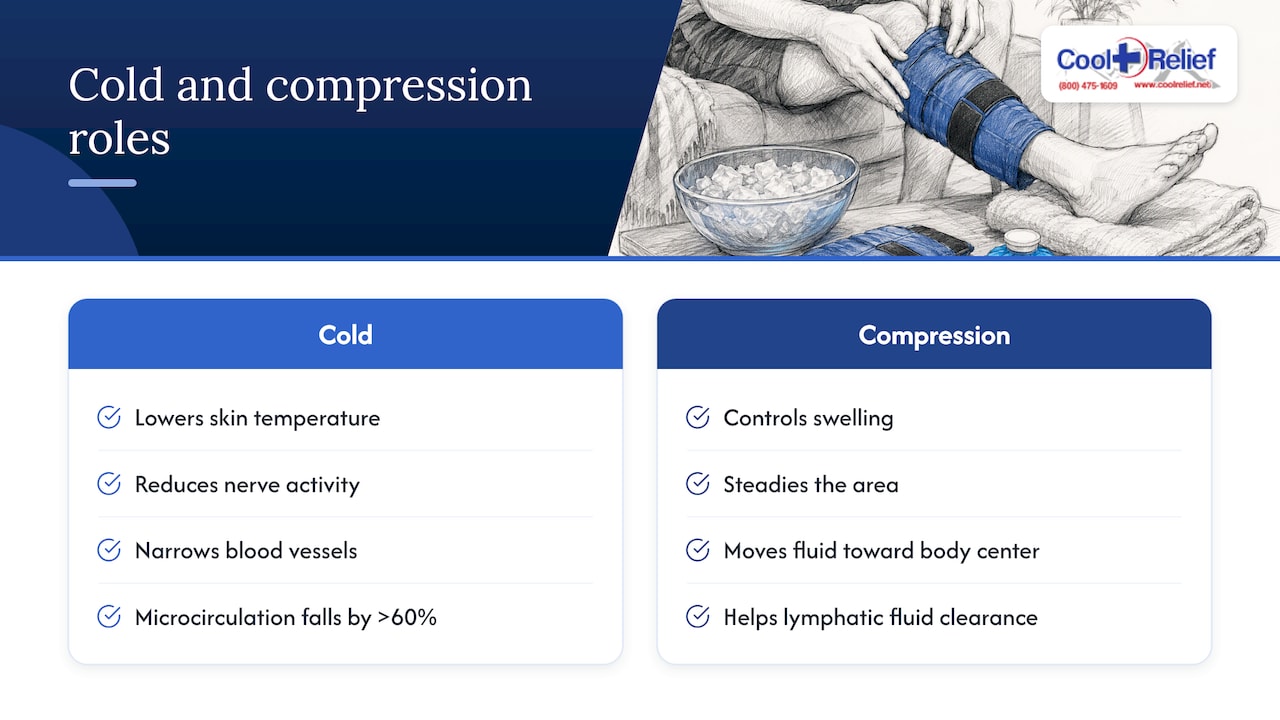
Cold. Johns Hopkins Medicine explains that icing lowers skin temperature, reduces nerve activity and reduces pain and swelling. A 2010 review by Jon Block in the journal PMC found that cold slows the metabolic rate of soft tissue. It also found that local cooling narrows blood vessels and lowers microcirculation by more than 60%, an effect that lasted up to 30 minutes after the cold was removed.
Compression. Pressure helps control swelling and steadies the area so it is less likely to be bumped or strained. The same review explains that compression helps push fluid toward tissues closer to the center of the body, where the lymphatic system clears it more efficiently.
Together. Block’s review reports that adding cold to compression increases the speed, size and depth of cooling and speeds up lymph drainage. That is why a wrap that cools and hugs the joint beats a loose bag of ice that slides around.
One detail worth knowing: cold works by drawing heat out of tissue, not by adding “cold” to it, according to the F.A. Davis AT Collection. Cold can also raise your pain threshold, so gentle exercises feel more comfortable. That is one reason therapists pair icing with rehab.
Benefits: what the research shows
The most useful finding for most readers is simple. Block’s review of 21 randomized controlled trials found that cold compression generally improved outcomes compared with no treatment after acute musculoskeletal injury or orthopedic surgery. Knee replacement trials generally showed better results, such as pain relief, than the alternatives they were compared with.
A 2023 systematic review of 22 studies and 1,424 patients, published in PMC, looked at cryotherapy after surgery on joints other than the knee. It found the hip showed the most consistent benefits across pain, pain medication use, swelling and blood loss. It also concluded that pairing cryotherapy with compression led to better outcomes than cold alone. After shoulder surgery, compression cryotherapy combined with continuous cryotherapy gave the best results.
What that means in daily life:
- Less pain and swelling in the first days after an operation or injury.
- More comfortable movement, which matters when you are trying to do your physical therapy.
- Support for common problems. Johns Hopkins lists runner’s knee, tendonitis, sprains, arthritis pain, swelling after a hip or knee replacement, swelling under a cast or splint, and low back pain as typical uses.
If you are choosing between a few ways to ice, our guides on ice versus compression and on icing with elastic wraps go deeper on why the two work better as a pair.
Cold compression after surgery
This is the situation most people searching this topic are in. You are home, the joint is sore and swollen, and you want something that helps without adding risk.
A few points to keep in mind:
- Your surgeon’s instructions come first. The FDA advises talking to your health care provider about the type of therapy (hot, cold or compression), how often and how long to use it, how long the breaks between sessions should be, and how long to stay on the plan.
- Protect the incision. Ask your care team whether and when the dressing should be covered or kept dry before you put anything on the area.
- Match the wrap to the joint. Knee, hip and shoulder surgery are very different shapes. A wrap made for that body part sits better and stays put.
- Time sessions around therapy. Many people ice before and after exercises, which fits with the pain-threshold effect described above.
We have step-by-step guides for two of the most common cases: using an ice wrap after knee surgery and icing after ACL surgery around your PT sessions. Our broader knee cold therapy guide covers safe times and tips.
Fracture swelling is a related situation. If a broken bone is behind your swelling, read more about compression therapy for fracture swelling and check with your orthopedic provider before adding anything under a cast or splint.
How to do cold compression therapy at home
Here is a routine built from published guidance. Your own provider’s plan overrides it.
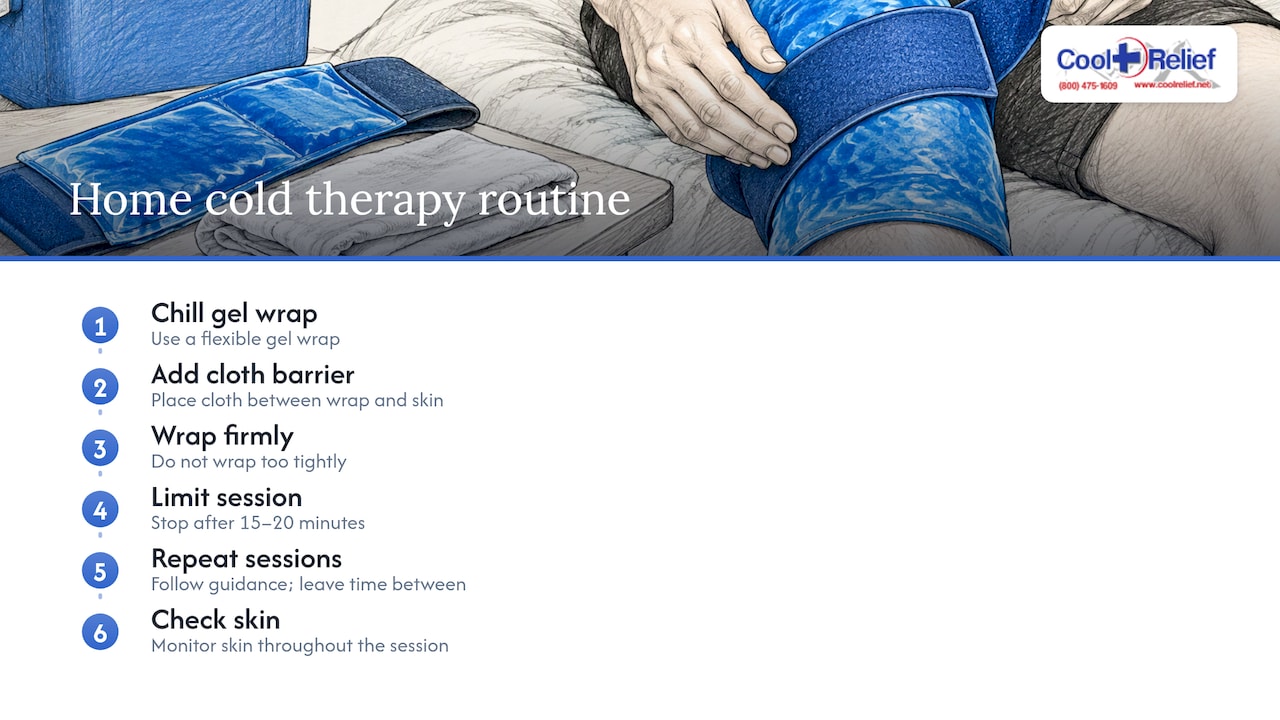
Step 1: Prepare the wrap
Chill your gel wrap in the freezer until it is cold and firm enough to hold its shape yet still flexible. Soft gel is meant to mold to the body, so it should bend around the joint.
Step 2: Put a barrier between the wrap and your skin
The FDA says to keep the wrap from touching bare skin, using a cloth or bandage barrier. Mayo Clinic also advises a dishcloth or thin towel between ice and skin. A thin shirt sleeve or cotton cloth works well.
Step 3: Wrap firmly, not tightly
UMass Memorial Health tells patients to use firm pressure without wrapping tightly. You want snug support, not a tourniquet. Toes or fingers should stay warm, pink and free of tingling. If they don’t, loosen the wrap.
Step 4: Keep sessions to 15 to 20 minutes
PM&R KnowledgeNow notes that at least 15 minutes is needed to get a pain-relieving effect, and that 20 minutes is the usually recommended duration. Mayo Clinic says never use ice for more than 20 minutes at a time. Johns Hopkins suggests about 10 to 20 minutes with an ice or gel pack, several times a day.
Step 5: Repeat through the day
For a fresh sprain, Mayo Clinic suggests icing 4 to 8 times a day for the first 48 hours or until swelling goes down. After surgery, follow your surgeon’s schedule. Let the area return to normal temperature between sessions.
Step 6: Check your skin
Look at the skin often during and after each session and keep it dry. Johns Hopkins says to stop if you lose feeling in the area. UMass Memorial adds that you should re-chill when a pad starts to feel warm, which is typically after 15 to 20 minutes.
If you also want a quick reference for timing and skin protection on the face or for arthritis, see our face cold therapy tips and arthritis cold therapy guide.
Who should be careful, and when to stop
Cold is safe for many people when used properly, and a few simple rules keep it that way. The FDA says the most serious cold-therapy injuries range from numbness to frostbite, and it notes that devices holding cold for long periods make correct use especially important. A gel wrap used with a barrier and a timer keeps you well within the usual guidance.
Stop and contact your provider if you notice: numbness, increased or unexpected pain, burning, itching, blisters or welts, more swelling, redness or discoloration. That list comes from the FDA.
Talk to your doctor before starting if you have:
- Poor tolerance to cold or cold hypersensitivity
- Raynaud’s disease
- Peripheral vascular disease or poor circulation
- Reduced sensation, such as neuropathy, or diabetes that affects how well you sense tissue damage
- Open wounds or burns in the area
- High blood pressure
The first five come from PM&R KnowledgeNow and Johns Hopkins. The F.A. Davis AT Collection also mentions hypertension.
Older adults. Reduced skin sensation is more common with age and with some conditions, so shorter sessions, a thicker cloth barrier and frequent skin checks are good habits. PM&R KnowledgeNow lists dementia and impaired ability to communicate among cautions, so a caregiver should supervise the sessions.
Children. Ask your child’s pediatrician about timing for their injury. Stay with the child during the whole session, use a cloth barrier and look at the skin often, since kids may not say when something feels wrong.
Headaches and stress. Many busy professionals use a cool wrap on the neck or face for short periods. Our Face/Neck Ice Wrap is made for that. Use the same barrier and timing rules, and see a doctor for headaches that are severe, sudden or keep coming back.
Choosing a wrap that works at home
What you want from a home wrap is straightforward:
- A fit for the joint. Cold only helps where it touches. Knee, shoulder, hip, back, ankle, wrist, jaw and face are all shaped differently.
- Flexibility. Soft gel bends with you, so you can sit, rest or walk to the kitchen without the wrap stiffening up.
- Reusability. You refreeze it and use it again, with no ice cubes and no leaks on your bandages.
- Heat when you need it. Cold is typically for the early, swollen phase of an injury. Heat is for tight, stiff muscles and joints. Having both in the same style of wrap keeps things simple.
A quick match-up:
| Situation | Where to start |
|---|---|
| Knee surgery or knee pain | Knee Ice Pack Soft Gel |
| Wrist or elbow soreness | Wrist Ice Pack |
| Several body parts in one household | Large Universal Soft Compression Ice Wrap |
| Shoulder, hip, back, ankle, jaw, face or neck | The matching wrap in our full range |
If you are also thinking about full-body cold plunges, see our comparison of an ice bath versus an ice pack. The FDA separately notes that whole-body cryotherapy carries a different set of risks and that its healing benefits are unconfirmed, so a targeted wrap on the sore joint is the approach this article is about.
Our perspective
We make reusable ice and heat wraps, so we think about one question a lot: what makes someone actually use their cold therapy as often as their recovery plan says?
Our answer is comfort and fit. A wrap that slides around, drips or goes stiff in the cold gets left in the freezer. Our soft gel wraps are designed to bend around the knee, shoulder, hip, back, ankle, wrist, jaw or face, so cold and light pressure stay where you need them.
The research backs the pairing. Reviews of randomized trials report better outcomes when cold and compression are combined, and that is why we put the two together in one wrap you can wear while you rest at home. Because the same wrap family covers cold and heat, you can follow your provider’s plan as it changes from the first swollen days to the stiffer weeks.
Use a barrier, watch the clock, check your skin, and follow your surgeon’s instructions. Those habits matter more than anything else on this page.
Cool Relief
Ready to try a wrap?
If you are recovering from surgery, managing a sports injury or soothing a sore joint, our reusable soft gel wraps are made for cold therapy at home, with flexible fit for the body part you are treating. Browse the full Cool Relief range to find the wrap for your knee, shoulder, hip, back, ankle, wrist, jaw or face. We also make heat wraps and a Shower Shield. 🙂
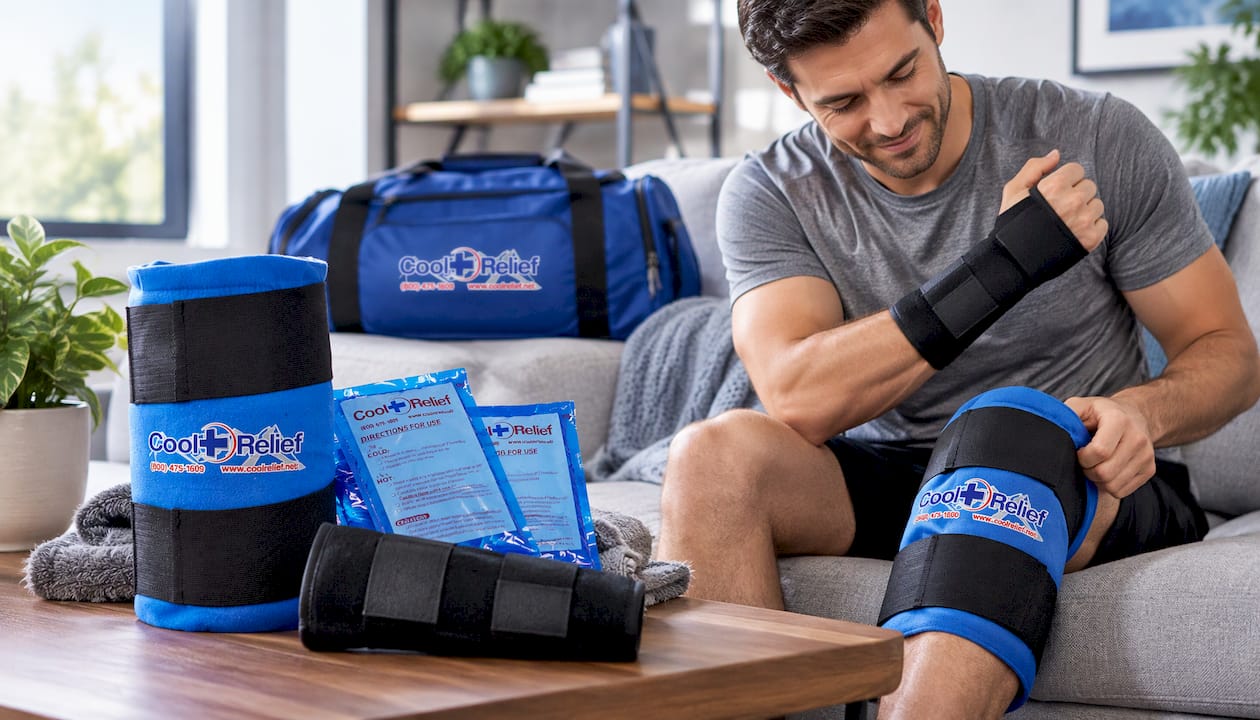
Both the cold and the heat wraps sit on the same site, so you can order what fits your recovery stage in one place.
FAQ
What does cold compression therapy do?
It lowers temperature in the treated area, which reduces nerve activity, pain and swelling, while pressure helps move fluid out of the tissue. Johns Hopkins describes this as the cold and compression parts of R.I.C.E. Reviews of randomized trials report generally better outcomes after acute injury or orthopedic surgery.
How long should I use cold compression at a time?
Most published guidance points to 15 to 20 minutes per session, and never more than 20 minutes at once for ice, according to Mayo Clinic. Use a cloth between the wrap and your skin and take breaks between sessions. After surgery, your surgeon’s schedule takes priority.
Can I use cold compression therapy at home?
Yes. Home discharge instructions from health systems such as UMass Memorial describe using a cold device with a cloth barrier, firm but not tight pressure and regular skin checks. A reusable gel wrap follows the same principles with a simple freezer-based setup.
When should I not use cold therapy?
Talk to your doctor first if you have Raynaud’s disease, poor circulation, reduced sensation from neuropathy or diabetes, cold hypersensitivity or open wounds in the area. Stop right away and call your provider if you have numbness, burning, blisters, increased swelling or skin color changes.
Is cold compression the same as just icing?
Icing is the cold part. Cold compression adds steady pressure on top of it. A 2023 review of postoperative studies concluded that pairing cryotherapy with compression led to better outcomes than cryotherapy alone.
Sources
- Cold Facts to Help Avoid Injury from Water-Circulating Hot/Cold Therapy Devices, FDA
- Cold and compression in the management of musculoskeletal injuries and orthopedic operative procedures, Block 2010, PMC
- Postoperative Cryotherapy in Joints Other Than the Knee, PMC
- Cryotherapy Cold Therapy for Pain Management, Johns Hopkins Medicine
- Sprain: First aid, Mayo Clinic
- Discharge Instructions: Using a Cold Water Therapy Device, UMass Memorial Health
- Therapeutic Modalities: Thermal, PM&R KnowledgeNow
- Cold Therapy Modalities, F.A. Davis AT Collection
Share and get 15% off!
Simply share this product on one of the following social networks and you will unlock 15% off!